
How Smart Project creates creatives that sell: an inside look at the production process
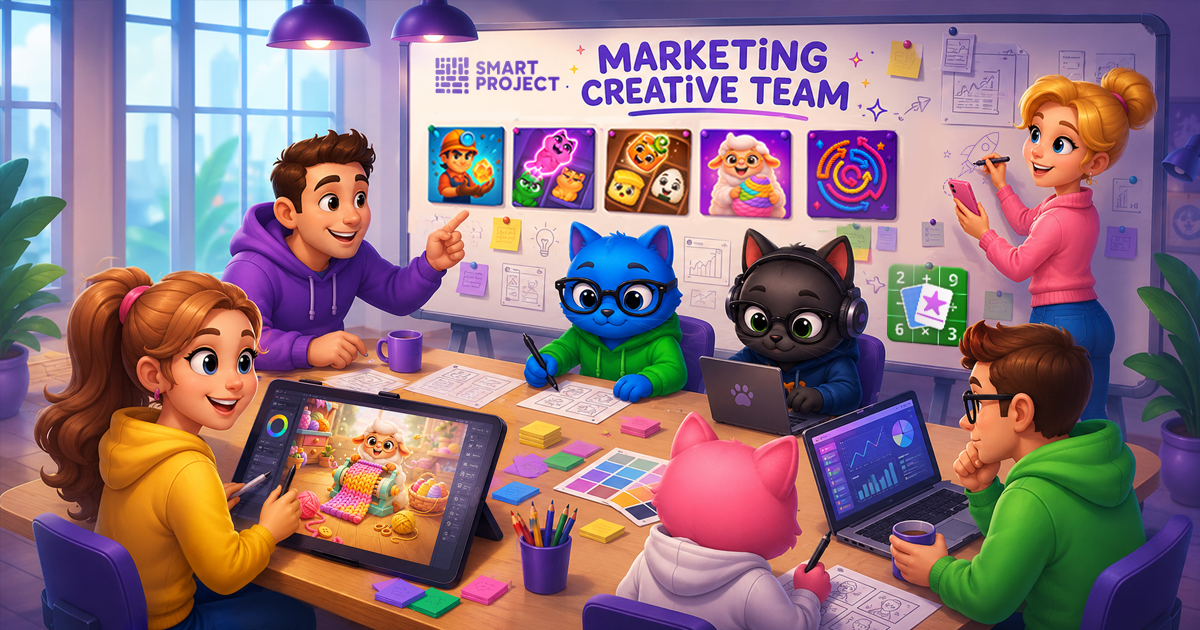
In mobile game development, creatives are not art for the sake of art. They are tools that either generate revenue or they don’t. But behind this rational approach lies a much more complex system — one built on psychology, experimentation, sometimes strange decisions, and a constant search for balance between what is “interesting” and what is “effective.”
We spoke with Smart Project’s Creative Producer Rostyslav to understand what this process actually looks like from the inside.
Not “success or failure”, but a continuous flow of hypotheses
In traditional advertising, there’s a concept of a “failed commercial”. In performance marketing, things work differently.
“Most creatives aren’t really “failures” — they’re simply hypotheses that weren’t confirmed”.
And this is probably one of the key differences between creative production in game development and traditional advertising approaches. The team doesn’t work around a few isolated “big ideas,” but instead operates through a constant stream of experiments:
- dozens of hypotheses are created,
- each is tested through the market,
- successful ones are scaled,
- the rest are filtered out.
In such a system, the goal is not to “guess right” on the first try, but to test quickly and adapt even faster. Because even a seemingly strong concept may fail with a specific audience, while at times a weird or almost random idea unexpectedly delivers the best results.
This represents a fundamental shift in mindset: mistakes are not feared — they are built into the system.
Psychology: playing on the edge of frustration
One of the key tools in creative production is emotional manipulation — and most often, it’s not about “happy emotions,” but rather tension, frustration, or even irritation.
For example, in the case of Kitty Sort, the team intentionally left the level unfinished in the creative, triggering an internal urge to “finish sorting.”
But this always raises an important question: where is the line between intrigue and annoyance?
“That’s something we try to sense professionally. And… test.”
In reality, there is no universal limit. Some concepts perform better with light frustration, while others require a much more aggressive emotional approach. Even very similar creatives may demand completely different levels of emotional pressure.
The answer is not intuition or strict rules — it’s iteration.
When the numbers say “No,” but the idea is still alive
From the outside, analytics may seem like the final judge that either validates an idea or kills it. But internally, the process is far more flexible.
“Sometimes the first version doesn’t perform, but other iterations of the same idea suddenly take off.”
And very often, the issue is not the concept itself, but the details:
- pacing,
- the first few seconds,
- colors,
- editing,
- frustration level,
- or even the call-to-action.
The exact same idea can come back to life in a completely different form. That’s why speed is so critical in production. The market consumes formats incredibly quickly, and even a successful creative can stop performing within just a few weeks.
As a result, the creative process increasingly resembles a live system:
- constant iterations,
- rapid testing,
- adaptation to market changes,
- and an almost continuous cycle of idea renewal.
So bad it’s good
Another less obvious layer of creative production is the use of discomfort.
There are creatives on the market that are intentionally unpleasant, weird, or even disgusting.
“For example, themes like acne, nails, or even toilet-related stories — in some niches, they actually work”.
This completely contradicts the classical idea of a “beautiful creative,” but fits perfectly into the reality of performance marketing:
The main goal is to capture attention — not necessarily to be liked.
Creativity without burnout
When working with hundreds or even thousands of creatives, burnout would seem inevitable. But the team approaches things differently.
“We have products with more than a thousand creatives. Burnout? What’s that?”
The reason lies in constant movement:
- brainstorming in different formats,
- involving multiple roles (including product teams),
- competitor analysis,
- fast idea → execution → result cycles.
The routine never becomes stagnant because it is constantly being restarted.
Why “copying competitors” isn’t enough
Competitor analysis is a huge part of the creative team’s work. But in reality, it’s not about direct copying.
“Just because something worked in another game doesn’t mean it will work in yours. Even if the mechanics are very similar.”
Creatives do not exist separately from the product itself. Everything affects performance:
- the game’s visual style,
- the audience,
- emotional tone,
- even how tired the market already is of a certain format.
That’s why references are not treated as “copy and paste,” but rather as a way to understand patterns, adapt them, and test them within the team’s own context.
And sometimes, this adaptation process leads to ideas that later reshape the product itself.
Ethics and misleading ads: what has changed
A few years ago, the market widely tolerated harsh misleading ads — creatives that had almost nothing in common with the actual game. Today, that has changed.
“Now, even misleading creatives need to communicate the essence of the game. Completely disconnected creatives perform much worse.”
And this is not only about ethics — it’s also about business.
Audiences acquired through fully deceptive creatives usually show weaker retention and lower monetization performance.
In our own work, we also moved away from that approach, while still evolving some of the processes:
Exaggeration is acceptable.
Changing the presentation is acceptable.
But the connection to the product must remain.
Artificial intelligence: not a replacement, but an amplifier
AI has already become part of the team’s daily pipeline, though not as an attempt to “automate everything.”
“We use it wherever it makes sense: video generation, idea discovery, automation.”
What does this provide?
- faster production,
- support during ideation,
- elimination of routine tasks.
But the key point is not about replacing people.
AI does not create the system by itself. It only amplifies a team that already understands what to test, for whom, and why.
Creatives that influence the product
One of the most interesting aspects of the team’s work is the moment when marketing stops being just a “wrapper” and starts influencing the game itself.
In the Kitty Sort case, one of the creative mechanics:
- was first spotted in the market,
- then adapted for the product,
- tested in advertising,
- and after successful results, integrated directly into the game itself.
This creates a closed-loop system:
market → creative → data → product → new market.
And this is highly revealing, because creatives no longer exist separately from the product or marketing. All of these processes are gradually beginning to shape one another.
Conclusion: creativity as a system
Creative production at Smart Project is not about inspiration or “one successful video.”
It is a system where:
- mistakes are part of the process,
- psychology is tested rather than guessed,
- even strange ideas get a chance,
- ethics evolve together with the market,
- and technology amplifies people instead of replacing them.
And most importantly: creativity here is not about being liked.
It’s about working.